



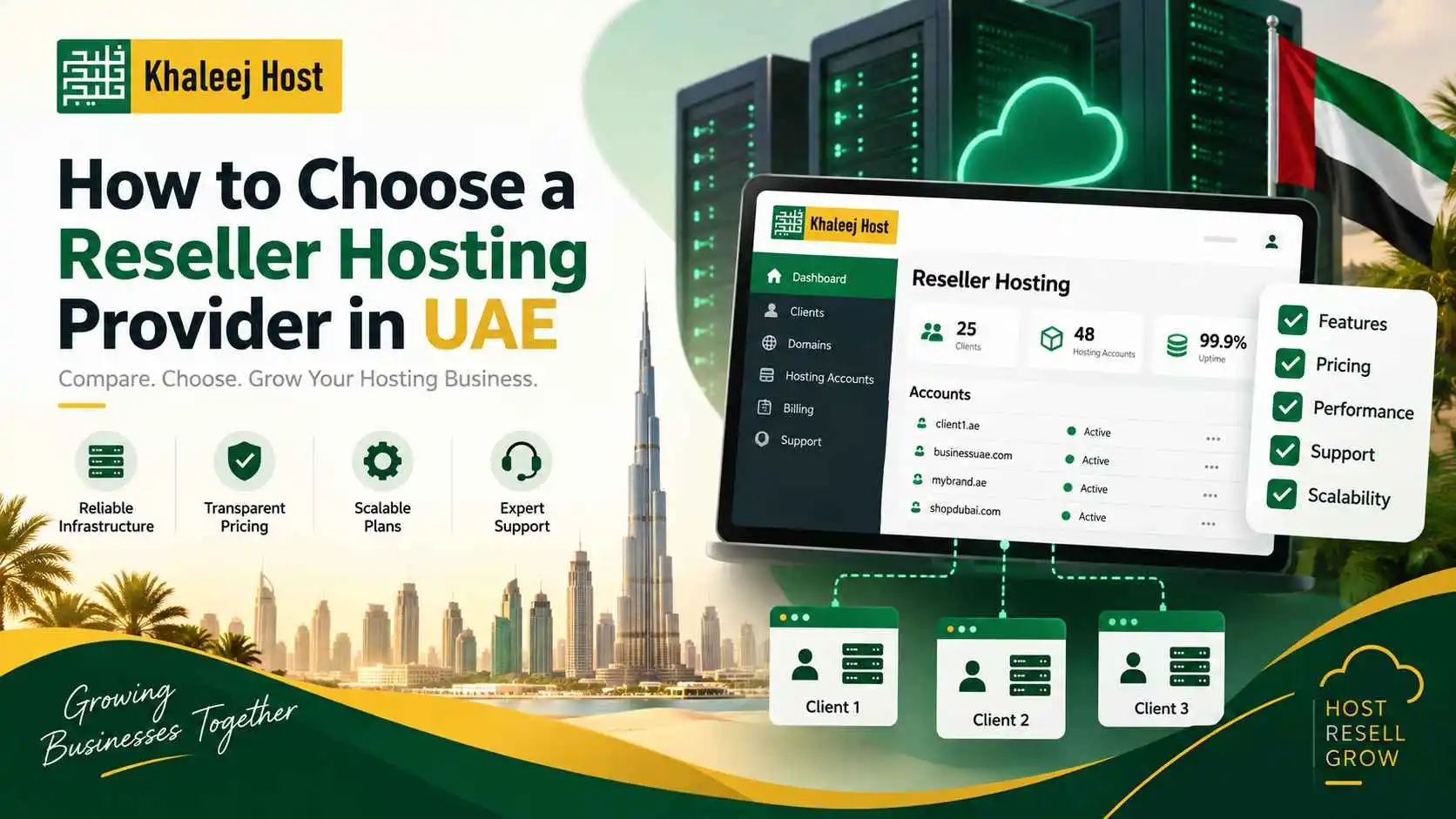
Choosing a reseller hosting provider in the UAE is an important business decision. The provider you choose can directly affect your clients’ website performance, security, support experience, and your ability to grow your hosting business.
A low price may look attractive at first, but it does not tell you whether the plan has enough resources, reliable support, useful management tools, or a practical upgrade path.
Whether you are a web designer, freelancer, digital agency, developer, or planning to start your own hosting business, you need a reseller hosting provider that fits your actual business requirements.
This guide explains what to check before buying reseller hosting in the UAE, from WHM and cPanel to server resources, backups, white-label features, support, pricing, and scalability.
What Is Reseller Hosting?
Reseller hosting allows you to purchase hosting resources from a hosting provider and use them to create separate hosting accounts for your own customers.
Instead of managing physical servers yourself, you use the provider’s hosting infrastructure and manage your client accounts through reseller tools such as WHM.
For example, a web design agency can build websites for UAE businesses and host those websites through its own reseller hosting account. Each client can have a separate hosting account while the agency manages everything from a central environment.
If you are still learning about the business model, our guide to Reseller Hosting in UAE: Complete Guide to Starting and Growing a Hosting Business explains how reseller hosting works and where it fits into a hosting business.
What to Look for in a Reseller Hosting Provider in UAE
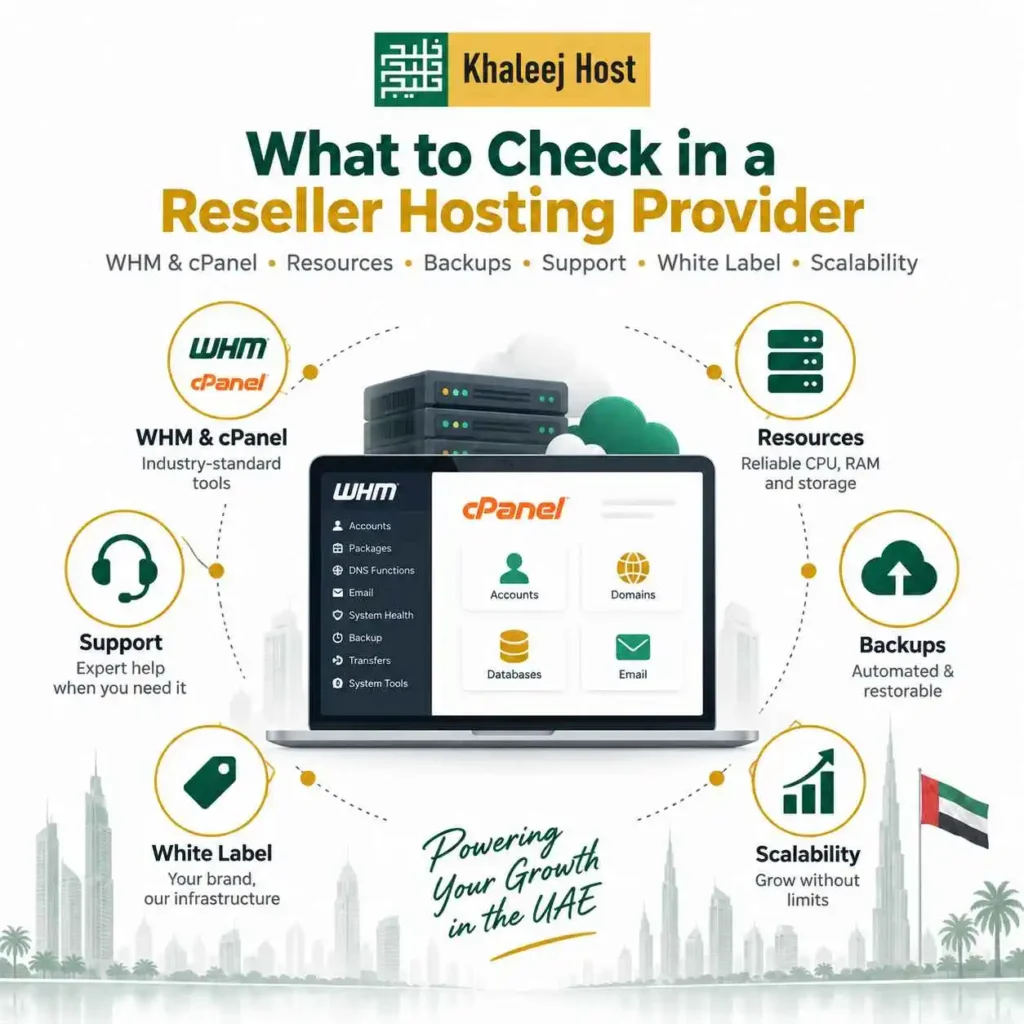
Not every reseller hosting plan offers the same level of resources, management, support, or flexibility.
Before choosing a provider, evaluate the following factors.
WHM and cPanel Access
WHM and cPanel serve different purposes in a reseller hosting environment. So, WHM gives you higher-level control over hosting accounts. You can use it to create accounts, assign packages, manage resources, and handle multiple customers from one dashboard.
cPanel is designed for individual hosting accounts. Your clients can use it to manage websites, domains, email accounts, databases, files, SSL, and other hosting functions.
Understanding cPanel vs WHM for reseller hosting helps you evaluate whether a provider is giving you the level of control you actually need.
Do not simply look for the words “WHM” and “cPanel” on a pricing page. Check what functionality is included with your specific reseller plan.
Server Performance and Reliability
Your customers may not know what server configuration is being used, but they will notice when their website loads slowly or becomes unavailable.
Hosting performance can affect:
- Website loading experience
- Customer experience
- Online sales
- Lead generation
- Website engagement
- Client satisfaction
When comparing providers, look beyond a basic uptime claim. Check the resources assigned to your reseller account and understand whether CPU, memory, storage, bandwidth, and other limits apply.
Also consider the types of websites you will host. A simple company website may have modest requirements, while an ecommerce store or busy WordPress website can require considerably more resources.
Hosting Resources and Account Limits
One of the most important parts of a reseller hosting plan is its actual resource allocation.
Check:
- Storage capacity
- Bandwidth
- CPU resources
- Memory limits
- Number of cPanel accounts
- Domains
- Databases
- Email accounts
- Inodes
- Backup storage
- Resource usage policies
Do not automatically choose the package with the highest numbers.
If you are starting with five small business websites, buying a plan designed for dozens of high-traffic websites may unnecessarily increase your costs.
On the other hand, choosing a plan that is too restrictive can create problems when you add new clients.
The goal is to find a balance between your current requirements and realistic business growth.
White-Label Reseller Hosting
If you want customers to see hosting as part of your own business, white-label functionality can be valuable.
With white-label reseller hosting in UAE, you can offer hosting under your own brand rather than making the underlying provider the focus of your client relationship.
This can be useful for:
- Web design agencies
- SEO agencies
- Digital marketing companies
- Freelancers
- Developers
- IT service providers
- New hosting businesses
Depending on the provider, white-label functionality may involve private nameservers, custom branding, client-facing information, or other reseller features.
Before buying, check exactly what the provider means by “white label” instead of assuming every white-label plan includes the same features.
Technical Support
Support becomes especially important when you are responsible for several client websites.
If a server-side issue affects multiple accounts, you need a provider that can help resolve the infrastructure problem quickly.
Before choosing a reseller hosting provider, check:
- Available support channels
- Support hours
- Technical support scope
- Response process
- Server-level assistance
- Migration assistance
- Backup restoration support
- Escalation options
You should also understand your own support responsibilities.
For example, a server configuration problem may require your hosting provider’s assistance, while a broken WordPress plugin may fall under your responsibility as the website manager.
Clear boundaries can prevent unnecessary delays and client frustration.
Check Backup and Security Features
Backups should never be treated as an afterthought when you are managing client websites.
Before purchasing reseller hosting, find out:
- How frequently backups are created
- How long backups are retained
- Where backups are stored
- Whether restoration is available
- Whether backup restoration has additional charges
- What happens if an account needs to be restored
You should also review the provider’s security features.
Depending on the hosting environment, these may include server-level protection, malware monitoring, firewalls, SSL support, account isolation, and protection against common attacks.
Do not assume that “backup included” means every recovery scenario is covered. Read the actual backup and restoration policy.
Compare Value Instead of Just Price
Price matters when you are building a hosting business, but the cheapest reseller hosting plan is not automatically the most practical option.
Imagine two plans:
- Plan A has a lower price but limited resources and fewer management features.
- Plan B costs more but provides better resources, useful reseller tools, backups, and a clearer upgrade path.
The better commercial fit depends on what your clients need and how you plan to operate.
Instead of asking only:
“Which reseller hosting plan is cheapest?”
Ask:
“What am I getting for the price, and will this plan remain practical as my client base grows?”
Reseller Hosting Comparison Checklist
| Factor | What to Check |
| Price | Starting price and renewal cost |
| Accounts | Number of client accounts allowed |
| Storage | Total storage and usage restrictions |
| Bandwidth | Allocation and fair-use conditions |
| WHM | Account and package management |
| cPanel | Client-level hosting management |
| Backups | Frequency, retention, and restoration |
| Security | Server and account protection |
| Support | Channels and technical assistance |
| White Label | Branding and private nameserver options |
| Scalability | Upgrade options |
| Billing | Automation and WHMCS compatibility |
This type of comparison gives you a clearer picture than looking at the advertised price alone.
Choose a Provider Based on Your Client Websites
Your hosting requirements depend heavily on the websites you plan to manage.
A portfolio of small business websites may need relatively modest resources.
An ecommerce website may require more capacity because it can involve:
- Product databases
- Customer accounts
- Orders
- Payment integrations
- Larger databases
- Traffic fluctuations
- Frequent backups
WordPress websites can also vary significantly depending on their plugins, themes, traffic, media files, and functionality.
Before choosing a reseller hosting plan, make a simple list of your expected client websites.
Then estimate:
- How many websites you will host
- What platforms they use
- Their approximate traffic
- Storage requirements
- Email requirements
- Database requirements
- Expected growth
This makes your decision much more practical.
Look for an Easy Client Management System
Managing one website is very different from managing 20 or 30 client accounts.
A good reseller hosting setup should make common tasks straightforward.
You may need to:
- Create hosting accounts
- Assign hosting packages
- Suspend accounts
- Change resource limits
- Manage domains
- Create email accounts
- Manage databases
- Monitor account usage
- Handle backups
- Migrate websites
WHM can make these tasks easier by providing centralized account management.
If you are new to the business, our guide on How to Start a Reseller Hosting Business in the UAE: Step-by-Step Guide can help you understand how hosting packages, client accounts, branding, pricing, and support fit together.
Check Billing and Automation Options
If you plan to sell hosting to multiple customers, manual billing can become difficult to manage.
Look for support for tools and systems that can help with:
- Recurring billing
- Invoices
- Payment reminders
- Hosting activation
- Account suspension
- Client notifications
- Service management
WHMCS can be useful for hosting businesses that want to automate parts of the customer lifecycle.
You do not necessarily need advanced automation when you have only a few clients. However, checking compatibility early can prevent operational problems later.
Review the Provider’s Upgrade Path
Your first reseller hosting plan does not necessarily need to support your business forever.
As your customer base grows, you may need:
- Additional storage
- More CPU resources
- More memory
- More hosting accounts
- Greater control
- Dedicated resources
- VPS hosting
Before signing up, check how upgrades work and whether you can move to a higher hosting level without rebuilding your entire business setup.
This is particularly important if your long-term plan involves moving from reseller hosting to VPS.
Our guide on Reseller Hosting vs VPS for Starting a Hosting Business: Cost, Control and Scalability explains the major differences between these two options.
Check Migration Support
Website migration can become a major concern when you already have clients hosted elsewhere.
A provider that offers practical migration support can make the process easier.
Before moving a website, clarify:
- What the provider will migrate
- Whether migration is included
- How email accounts are handled
- How databases are transferred
- How DNS changes are managed
- How downtime is minimized
- Whether migration assistance has additional charges
A migration plan should account for both the website and its supporting services.
For business websites, email disruption can sometimes be just as problematic as website downtime.
Read the Terms Before Buying
Do not make your decision based only on the features displayed on the main pricing page.
Read the provider’s terms carefully and check:
- Renewal pricing
- Resource restrictions
- Backup retention
- Refund policy
- Account limits
- Acceptable-use policy
- Support scope
- Migration terms
- Upgrade costs
- Cancellation process
A low introductory price may not represent the actual long-term cost of running your hosting business.
Understanding the full pricing structure helps you build more realistic hosting packages for your customers.
Common Mistakes When Choosing Reseller Hosting
Choosing Only on Price
A cheaper plan may reduce your initial cost, but poor resources or limited support can create problems once you start hosting real clients.
Buying Too Many Resources
The opposite mistake is paying for capacity you do not currently need.
If you have only a few small websites, start with realistic requirements and upgrade when your business actually needs more capacity.
Ignoring Support
When several client websites depend on your reseller account, technical support becomes part of your business continuity.
Always understand how the provider handles server-level problems.
Assuming All Reseller Plans Are the Same
Two providers can offer “reseller hosting” while providing very different resource limits, support, infrastructure, backups, and management tools.
Compare the actual specifications rather than the package name.
Forgetting About Growth
Your hosting requirements can change as your client base grows.
Choose a provider that gives you a realistic upgrade path instead of forcing you to change providers whenever your business expands.
Is Reseller Hosting Suitable for Your Business?
Reseller hosting can be useful for businesses that already provide website-related services and want to add hosting to their offering.
It can fit:
- Web design agencies
- Freelance developers
- SEO agencies
- Digital marketing companies
- IT service providers
- Website maintenance businesses
- Entrepreneurs starting a hosting business
It can also create an additional recurring revenue stream when hosting is packaged with website development, maintenance, SEO, or other digital services.
However, the numbers need to make sense for your particular business.
If you want to understand the financial side, read Is Reseller Hosting Profitable in the UAE? Costs, Pricing and Revenue Explained before setting your own hosting prices.
Why KhaleejHost for Reseller Hosting in UAE?
For businesses looking for reseller hosting in the UAE, KhaleejHost provides reseller hosting with WHM and cPanel, along with white-label capabilities and tools for managing multiple client hosting accounts.
This can make the setup practical for agencies, freelancers, developers, and businesses that want to offer hosting under their own service portfolio without managing physical server infrastructure themselves.
The right plan still depends on your requirements.
Before choosing a package, consider your expected number of clients, website types, storage requirements, resource usage, support needs, and growth plans.
That approach helps you choose hosting based on your business rather than simply choosing the most expensive or cheapest package.
A Practical Checklist Before You Buy
Before purchasing reseller hosting, go through this checklist:
- Does the plan include WHM and cPanel?
- Are the resource limits suitable for your client websites?
- Are backup policies clearly explained?
- Is the security setup suitable for your requirements?
- Is technical support available when you need it?
- Does the plan support white-label branding?
- Are private nameservers available if required?
- Can you create separate accounts for each client?
- Is there a clear upgrade path?
- Are renewal prices transparent?
- Does the provider support your website platforms?
- Are migration options available?
- Can the hosting setup support your expected business growth?
If you can answer these questions clearly, you have a much stronger basis for comparing reseller hosting providers.
Frequently Asked Questions
Compare server resources, WHM and cPanel access, backups, security, technical support, white-label options, account limits, pricing, migration support, and scalability. The right provider should match the websites you plan to host and your expected business growth.
Check the actual resource limits, number of accounts, WHM and cPanel features, backup policy, security, support, renewal pricing, white-label options, migration assistance, and upgrade options.
Yes. Reseller hosting can allow agencies to host multiple client websites through separate hosting accounts while managing them from a centralized reseller environment. It can also be combined with website development and maintenance services.
WHM and cPanel serve different purposes. WHM is generally used by the reseller to manage hosting accounts, while cPanel is used at the individual account level for website and hosting management.
White-label reseller hosting allows you to offer hosting services under your own business branding. Depending on the provider, this may include features such as private nameservers and other branding options.
A low-cost plan can be suitable if its resources and features match your actual requirements. However, price should be compared with performance, support, account limits, backups, and future upgrade options rather than considered on its own.
Yes. Businesses can move from reseller hosting to VPS hosting when their technical or business requirements change. The decision depends on factors such as resource requirements, control, scalability, and server management needs.
Yes, if the provider offers appropriate white-label features. Check whether the plan includes private nameservers, branding options, and other client-facing features you need before purchasing.
Conclusion
Choosing a reseller hosting provider in the UAE is ultimately about finding the right balance between cost, performance, management, support, and future growth.
Do not choose a plan simply because it has the lowest price or the highest advertised resources. Look at what you will actually need to manage your clients successfully.
Check WHM and cPanel access, resource limits, backups, security, technical support, white-label options, billing capabilities, migration support, and upgrade paths.
If you are starting with a small number of clients, choose a practical plan that meets your current needs. As your hosting business grows, your provider should give you enough flexibility to increase resources or move toward a more advanced setup.