




Choosing reseller hosting is not only about storage, bandwidth, or the number of cPanel accounts you can create. You also need to decide how much server management you want to handle yourself.
This is where managed vs unmanaged reseller hosting becomes important.
With managed reseller hosting, the hosting provider takes care of more server-level tasks and technical support. With unmanaged reseller hosting, you generally get more responsibility and control over the technical side.
The right model depends on your technical skills, client requirements, available time, and the type of hosting business you want to build.
This guide explains the difference between managed and unmanaged reseller hosting, what each model includes, and how to decide which approach fits your business.
What Is Managed Reseller Hosting?
Managed reseller hosting is a reseller hosting model where the hosting provider handles a larger portion of the technical infrastructure and server-related management.
You still manage your reseller business and client hosting accounts, but you can rely on the provider for certain server-level tasks, troubleshooting, security-related issues, updates, backups, and infrastructure support, depending on the hosting package.
For example, imagine you run a web design agency and host websites for 20 clients.
If a problem occurs at the server level, you may not want to spend hours investigating configurations, services, or infrastructure issues. A managed hosting provider can handle the server-side problem while you focus on your clients and your core services.
This can be especially useful for businesses that want to offer hosting without building an in-house server administration team.
If you are new to the reseller hosting business, you can also review our guide on [how to start a reseller hosting business in the UAE] for a practical overview of the setup, client management, and business model.
What Is Unmanaged Reseller Hosting?
Unmanaged reseller hosting gives you more responsibility for the technical side of your hosting environment.
The provider supplies the infrastructure and hosting platform, but the level of server management and technical assistance may be more limited.
Depending on the provider and plan, you may need to handle more tasks yourself, such as:
- Server configuration
- Software and service management
- Troubleshooting
- Security configuration
- Performance optimization
- Technical monitoring
- Certain updates and maintenance tasks
This model can work for technically experienced developers, system administrators, or businesses that already have someone capable of handling server-related tasks.
However, you should always check the provider’s exact support scope. “Unmanaged” does not mean every task is automatically your responsibility, and different providers define support differently.
Managed vs Unmanaged Reseller Hosting: Key Differences
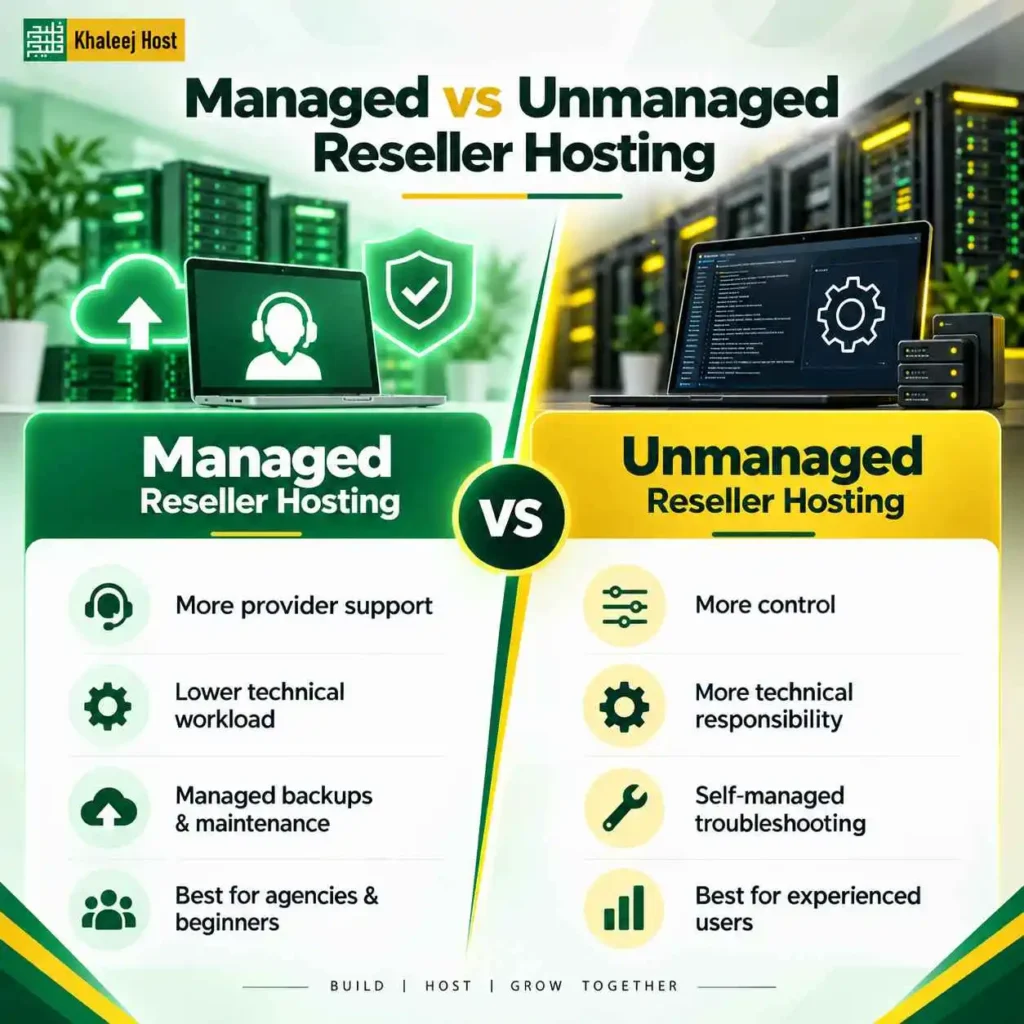
The main difference is responsibility.
| Factor | Managed Reseller Hosting | Unmanaged Reseller Hosting |
| Server management | More provider involvement | More responsibility for you |
| Technical support | Usually broader | Usually more limited |
| Server troubleshooting | Provider may assist | You may handle more yourself |
| Control | Less hands-on server control | More technical control |
| Technical knowledge | Lower requirement | Higher requirement |
| Time required | Generally lower | Generally higher |
| Business focus | More time for clients and services | More time spent on technical management |
| Flexibility | Depends on provider | Often greater technical flexibility |
| Cost | May be higher | May be lower |
| Best suited for | Agencies, freelancers, growing businesses | Technical users and experienced teams |
The exact features vary between hosting companies, so compare the actual service agreement rather than relying only on the “managed” or “unmanaged” label.
Managed Reseller Hosting: What Do You Usually Get?
Managed reseller hosting can include different levels of assistance depending on the provider.
Common areas may include:
Server-Level Technical Support
If the issue relates to the hosting infrastructure rather than your client’s website code, managed support may help investigate the problem.
This can reduce the amount of technical troubleshooting you need to perform yourself.
Server Maintenance
Some managed services include server updates, service monitoring, configuration work, and other maintenance tasks.
However, always confirm what is included before purchasing. A provider may manage the server while still expecting you to manage applications, plugins, themes, or custom website code.
Security Assistance
Managed hosting may include certain server-level security measures and monitoring.
Your clients’ websites still need proper security practices. Strong passwords, updated software, secure plugins, backups, and appropriate access controls remain important.
Backup Management
Depending on the plan, the provider may manage automated backups and restoration at the server level.
Before relying on backups, check:
- How often backups are created
- How long they are retained
- Where they are stored
- Whether restoration is included
- Whether backup storage has separate limits
A backup policy should be clear before you move client websites onto the platform.
Unmanaged Reseller Hosting: What Should You Expect?
Unmanaged hosting gives you more responsibility.
This can be useful if you already understand server administration and want greater control over your environment.
You may need to spend more time dealing with:
- Technical configuration
- Resource management
- Security settings
- Performance issues
- Troubleshooting
- Software compatibility
- Server-related maintenance
For a technically experienced team, this additional responsibility may not be a major problem.
For a freelancer who is already handling website development, SEO, client communication, content, and support, however, extra server management can quickly become another workload.
Which Reseller Hosting Model Is More Suitable for Beginners?
For beginners, the decision usually comes down to technical knowledge and how much responsibility they are comfortable managing.
If you are starting your first hosting business and do not have server administration experience, managed reseller hosting can provide more technical support.
You can focus on:
- Finding clients
- Creating hosting packages
- Managing client accounts
- Selling websites and hosting
- Handling customer communication
- Providing maintenance services
Instead of spending most of your time learning server administration.
On the other hand, if you already have strong technical skills, unmanaged hosting may give you the level of control you need.
The important question is not simply “Which one is cheaper?”
Ask yourself:
“How much technical work can I realistically manage every month?”
That answer can help you choose a more practical model.
Managed vs Unmanaged Reseller Hosting for Web Design Agencies
Web design agencies often bundle hosting with website development and maintenance.
For example, an agency might build websites for local businesses and then offer:
- Website hosting
- Domain management
- SSL
- Website maintenance
- Backups
- Security monitoring
- Technical support
Managed reseller hosting can fit this model when the agency wants to spend more time delivering client services instead of managing server infrastructure.
If your agency is also planning to generate recurring revenue from hosting, understanding the economics is important. Our guide on whether reseller hosting is profitable in the UAE explains the costs, pricing considerations, and revenue model in more detail.
Managed vs Unmanaged Reseller Hosting for Developers
Developers may have different requirements.
If you work with custom applications, advanced configurations, databases, or specific server environments, you may want greater technical control.
An unmanaged environment can give experienced developers more freedom to manage technical configurations.
However, compatibility should be checked before choosing a plan.
Ask the provider:
- Which operating system is used?
- Which PHP versions are supported?
- Which database systems are available?
- Are custom configurations allowed?
- What server access is provided?
- What technical support is included?
- Are application-level issues supported?
This prevents problems after moving client projects to the hosting environment.
Cost: Is Managed Reseller Hosting More Expensive?
Managed reseller hosting can cost more because you are paying for additional management and technical support.
But price alone does not tell you whether a plan makes financial sense.
Suppose you choose a cheaper unmanaged plan but spend several hours every month dealing with technical issues.
Your hosting bill may be lower, but the time cost can be higher.
For a business owner, that time could otherwise be used for:
- Client acquisition
- Website projects
- SEO services
- Social media marketing
- Customer support
- New hosting sales
This is why you should compare the total business cost rather than looking only at the monthly hosting price.
How to Compare Managed and Unmanaged Reseller Hosting
Before choosing a plan, create a simple comparison based on your actual business requirements.
1. Calculate Your Technical Skill Level
Ask whether you can comfortably troubleshoot server-related problems.
If the answer is no, managed support may be more practical.
2. Estimate Your Client Load
Hosting five websites is different from managing 50 client websites.
As your client base grows, a technical issue can affect multiple customers at once.
3. Check Support Boundaries
Do not assume “managed” means the provider handles everything.
Ask exactly what the support team will manage.
Also check what happens outside the included support scope.
4. Review Backup and Security Policies
Check whether backups, restoration, monitoring, and security assistance are included.
Do not make decisions based only on a single “backup included” statement.
5. Look at the Upgrade Path
Your hosting requirements can change as your client base grows.
Check whether you can increase resources or eventually move to a VPS.
Our guide on reseller hosting vs VPS for starting a hosting business explains the differences in control, cost, and scalability.
What About WHM and cPanel?
Managed and unmanaged reseller hosting can both provide WHM and cPanel, depending on the provider.
WHM is used to manage reseller-level hosting functions and client accounts.
cPanel is generally used at the individual hosting account level for tasks such as website files, email, databases, domains, and other hosting settings.
Understanding both is important when you plan to manage multiple client websites.
For a detailed explanation, read our guide on cPanel vs WHM for reseller hosting.
When Should You Choose Managed Reseller Hosting?
Managed reseller hosting may be worth considering if:
- You are new to hosting
- You do not have server administration expertise
- You run a web design agency
- You want to focus on clients instead of infrastructure
- You provide website maintenance services
- You want additional technical support
- Your team is small
- You value saving management time
The key benefit is not simply convenience.
It is the ability to keep your attention on the revenue-generating parts of your business while the provider handles the server-side responsibilities covered by your plan.
When Should You Choose Unmanaged Reseller Hosting?
Unmanaged reseller hosting may make sense if:
- You have strong server administration skills
- You have a technical team
- You need greater technical control
- You are comfortable troubleshooting infrastructure issues
- You have specific server requirements
- You want to manage more of the environment yourself
This model requires more technical responsibility, so make sure your team can handle that responsibility before choosing it for client websites.
Common Mistakes When Choosing Between Managed and Unmanaged Hosting
Choosing the Cheapest Plan
A low monthly price does not necessarily mean lower total business costs.
Consider your time, technical workload, support requirements, and potential downtime when comparing plans.
Assuming Managed Means Everything Is Covered
Always read the support terms.
Website code, WordPress plugins, custom applications, and third-party software may remain your responsibility.
Choosing Unmanaged Hosting Without Technical Skills
Saving money on hosting can become expensive if you need outside technical help whenever a server issue occurs.
Ignoring Your Future Client Base
Your requirements can change quickly once you start adding clients.
Choose a setup that gives you a clear path to expand.
Not Checking Migration Support
If you already manage websites elsewhere, ask whether the provider supports website and email migration and whether additional charges apply.
Can You Start With Managed Reseller Hosting and Move Later?
Yes, your hosting model can change as your business develops.
You may begin with managed reseller hosting because you want more technical support.
Later, if your team develops stronger server administration skills or your technical requirements change, you can evaluate other options.
Similarly, if reseller hosting starts becoming too restrictive because of resource requirements or technical control, moving to a VPS can become an option.
The important point is to check the provider’s upgrade and migration process before you need it.
Is Managed or Unmanaged Reseller Hosting Better for Your Business?
There is no single model that fits every reseller business.
Your decision should depend on how much technical responsibility you want to take on, the skills available in your team, the type of websites you host, your support requirements, and your expected growth.
Managed hosting can reduce the technical workload.
Unmanaged hosting can provide more hands-on responsibility and may suit technically experienced users.
Before buying, compare the actual support scope, resources, backup policy, security features, control options, pricing, and upgrade path.
Why Consider KhaleejHost for Reseller Hosting in UAE?
For businesses looking for reseller hosting in the UAE, KhaleejHost provides reseller hosting options designed for businesses managing multiple client websites.
The right setup depends on your requirements, so consider how many accounts you expect to manage, what types of websites your clients run, how much technical support you need, and how you plan to grow.
If you want to build hosting into your existing web design, development, SEO, or digital services, a reseller setup can give you a practical way to manage multiple client accounts from one hosting environment.
Frequently Asked Questions
Managed reseller hosting generally includes more provider assistance with server-level management and technical issues. Unmanaged reseller hosting gives you more responsibility for managing the technical environment.
Managed reseller hosting can be easier for beginners who do not have server administration experience because more technical support may be available. Always check what the provider actually includes.
It can be less expensive because you may receive less management and technical support. However, compare the total cost, including your time and any external technical support you may need.
Yes, reseller hosting plans can include WHM regardless of whether the service is managed or unmanaged. The exact features depend on the provider and package.
Yes. Reseller hosting is designed to let you create and manage hosting accounts for your own clients. You can package hosting with services such as web design, development, maintenance, or SEO.
It can be suitable for developers who have the technical knowledge required to manage the additional responsibilities. Check server access, supported technologies, and configuration options before purchasing.
Yes. Many businesses move to a VPS when they need more resources, control, or flexibility. Before choosing a reseller provider, check its available upgrade and migration options.
Check the exact support scope, server resources, backups, security features, WHM and cPanel access, account limits, migration support, renewal pricing, and upgrade options.
Conclusion
The difference between managed and unmanaged reseller hosting comes down to responsibility, control, technical support, and business priorities.
Managed reseller hosting can help you spend less time dealing with server-level tasks.
Unmanaged reseller hosting can suit businesses and developers that already have the technical skills to manage more of the environment themselves.
Before choosing either model, look beyond the advertised price. Review the support policy, resources, backups, security, account limits, control options, migration process, and upgrade path.
A reseller hosting plan should support the way your business operates today while giving you enough flexibility to handle tomorrow’s clients.
Ready to Choose Your Reseller Hosting Setup?
If you are planning to offer hosting to clients in the UAE, start by identifying how much technical management you want to handle yourself.
Explore KhaleejHost reseller hosting to review your available hosting options and choose a setup based on your client requirements, technical skills, budget, and growth plans.