



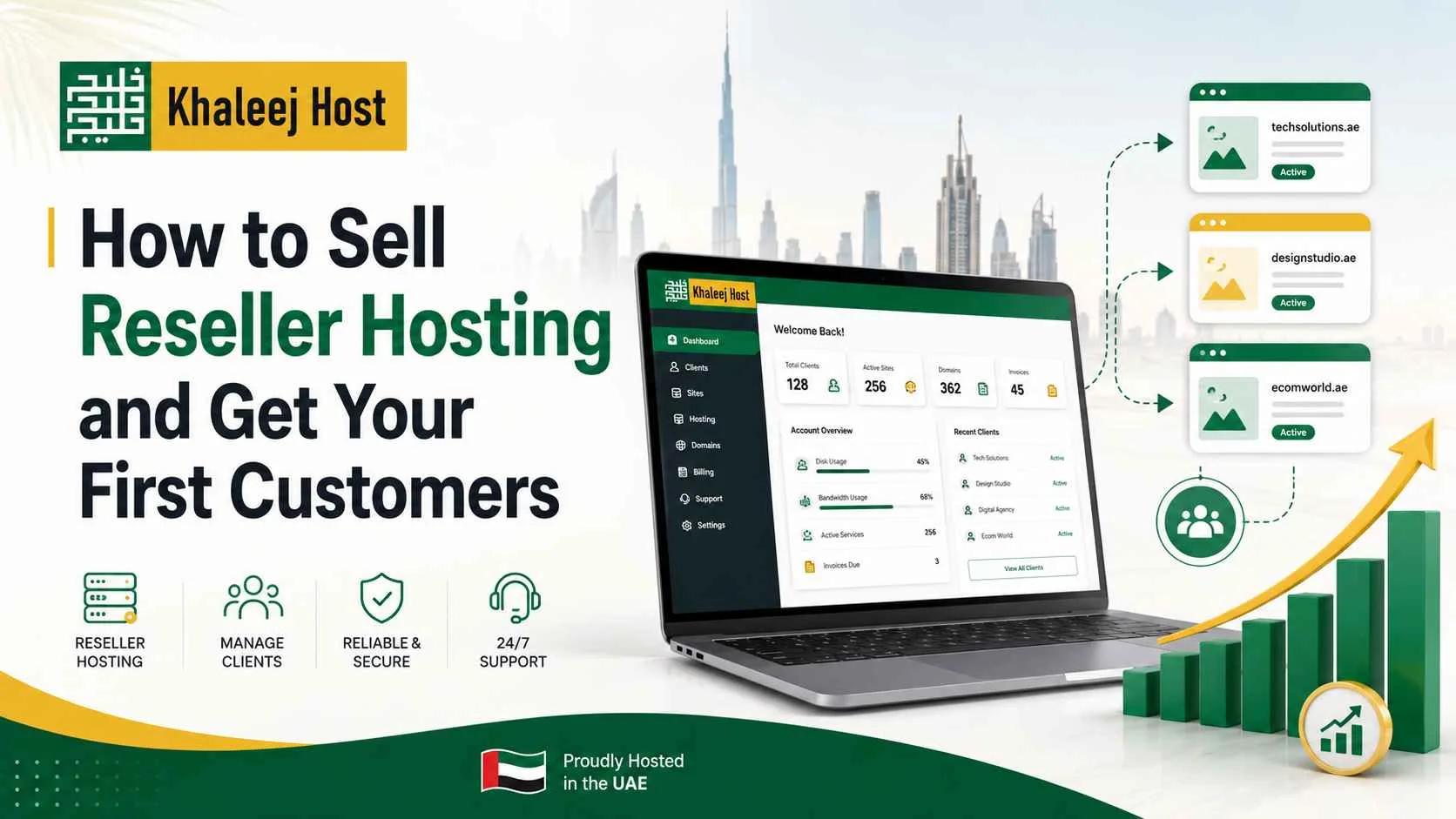
Starting a reseller hosting business is one thing. Getting your first paying customers is where the real business begins.
You can have reliable hosting infrastructure, attractive packages, and a professional website, but none of these will generate revenue unless potential customers understand your offer and have a reason to choose you.
The good news is that you do not need hundreds of customers to get started. A focused target market, a clear hosting offer, consistent outreach, and strong customer service can help you build your first customer base.
This guide explains how to sell reseller hosting and get your first customers, including where to find prospects, how to position your service, which sales channels to use, how to approach businesses, and what to do after your first sale.
If you are still researching the business model itself, the broader Reseller Hosting in UAE: Complete Guide to Starting and Growing a Hosting Business can help you understand the operational side before moving into customer acquisition.
Know What You Are Actually Selling
Before looking for customers, define your offer.
You are not simply selling storage, bandwidth, or a control panel. Most customers are buying a place to keep their website online without having to deal with complicated hosting issues themselves.
Your service may include:
- Website hosting
- Domain management
- Business email
- SSL support
- Website migration
- Hosting account management
- Technical assistance
- Backups, where included
- Website maintenance as an additional service
This distinction matters because customers usually care more about reliability, support, convenience, and ease of management than technical specifications alone.
Your sales message should therefore explain what the customer gets and why your service makes their life easier.
Choose a Specific Customer Segment
Trying to sell hosting to everyone makes marketing harder.
Start with one or two customer groups that are most relevant to your skills and existing network.
Potential audiences include:
Small Businesses
Local businesses often need a website, domain, professional email, and ongoing technical support but may not have an in-house IT team.
Web Design Agencies
Agencies already have customers who need hosting after their websites are completed. This makes them strong potential partners.
Freelancers and Developers
Developers managing multiple websites may benefit from having several customer accounts under one reseller environment.
Digital Marketing Agencies
Agencies working on websites, landing pages, SEO, and online campaigns may need reliable hosting for their clients.
Startups and New Businesses
New companies often need several digital services at the same time. Hosting can be introduced as part of their initial website setup.
Choosing a clear audience also makes your content, outreach, pricing, and sales conversations more specific.
Create Hosting Packages Around Customer Needs
Your hosting plans should be easy for a potential customer to understand.
Instead of presenting a long list of technical specifications, explain who each package is designed for.
For example:
| Package | Best For | Typical Need |
| Starter | Small websites | Basic hosting requirements |
| Business | Growing companies | More resources and business features |
| Agency | Developers and agencies | Multiple websites |
The actual resources should be based on your reseller account and the type of websites you intend to host.
Do not advertise resources you cannot consistently provide.
If you are still deciding what type of reseller setup makes sense for your target customers, compare the available hosting resources, management options, and scalability requirements before choosing your infrastructure.
Give Customers a Reason to Choose You
Your biggest challenge may not be explaining what reseller hosting is.
It may be answering:
Why should I buy hosting from you instead of an established hosting company?
Price alone is usually a difficult area for a small reseller to dominate.
Instead, build your value around services you can control.
You might offer:
- Personalised support
- Website migration assistance
- Local business support
- Easy account management
- Website maintenance
- Business email assistance
- Domain management
- Bundled digital services
For example, a web development company could provide:
Website Development + Domain + Hosting + Maintenance
A digital agency could offer:
Hosting + Website Management + SEO
This turns hosting into part of a wider solution instead of a standalone commodity.
Start With Existing Clients
Your existing customers are often the easiest place to find your first hosting sales.
If you build websites, review your previous projects.
Which customers already need hosting?
Which clients are approaching renewal with their current provider?
Which businesses are asking for website maintenance?
Which customers currently manage their hosting through a separate company?
These conversations can be much easier than cold outreach because you have already established trust.
A customer who knows the quality of your work is more likely to consider an additional service.
Turn Website Projects Into Recurring Hosting Customers
Website development naturally creates a hosting opportunity.
When a website is completed, the customer still needs:
- Hosting
- Domain management
- SSL
- Updates
- Backups
- Technical support
Instead of ending the relationship after website delivery, offer a suitable ongoing service.
The customer gets one point of contact.
You get an opportunity to build recurring revenue.
This is one of the most practical ways for agencies and developers to introduce reseller hosting without immediately investing heavily in customer acquisition.
For businesses considering the model from the beginning, it also helps to understand how to start a reseller hosting business in the UAE before designing the sales process.
Find Businesses That Already Have a Hosting Problem
Cold outreach works better when you approach businesses with an identifiable need.
Look for websites that show signs such as:
- Poor performance
- Outdated technology
- Missing HTTPS
- Frequent availability problems
- Unprofessional email
- Difficult website management
- Poor mobile performance
- Recently launched websites
- Website redesign activity
Do not assume a website has a hosting problem just because it looks outdated.
Research the business first.
Your goal is to identify a genuine opportunity rather than inventing a problem to make a sale.
Use Direct Outreach Strategically
Direct outreach can help you find your first customers when done properly.
A simple process works well:
Research → Personalise → Contact → Discuss → Recommend → Follow up
Research the Prospect
Understand what the business does and what its website requires.
Personalise the Message
Mention something relevant to the business instead of sending a generic advertisement.
Start a Conversation
Keep the initial message short and focused on the customer’s needs.
Ask Questions
Understand their current hosting provider, website requirements, support expectations, and problems.
Recommend a Solution
Only recommend a package after understanding what they actually need.
Follow Up
Give interested prospects time to evaluate the offer and follow up professionally.
The purpose of outreach is not to pressure someone into buying.
It is to find businesses where your service genuinely makes sense.
Build Partnerships With Web Developers
You do not have to find every customer yourself.
A partnership with web developers can create a steady source of hosting accounts.
Many developers prefer to focus on development rather than managing hosting infrastructure for every client.
You can provide the hosting environment while the developer manages the client relationship.
Depending on your arrangement, the developer could:
- Refer customers to you
- Bundle hosting with development
- Resell your hosting
- Use your infrastructure for client websites
- Offer hosting under a supported white-label arrangement
A good partnership should clearly define responsibilities, billing, support, migrations, and customer ownership.
Work With Digital Marketing Agencies
Digital agencies are another potential source of customers because they often manage websites and landing pages for multiple clients.
A marketing agency may need hosting for:
- Client websites
- Landing pages
- Campaign websites
- WordPress websites
- Temporary marketing projects
Rather than selling one hosting account at a time, an agency partnership can potentially introduce multiple websites.
If you offer white-label services, this becomes particularly relevant because the agency may want the hosting service to remain under its own customer-facing brand.
Our guide to white-label reseller hosting in UAE explains how this model works and where branding fits into a reseller business.
Use Website Migration as a Sales Opportunity
Website migration can remove one of the biggest barriers to switching hosting providers.
Customers may stay with an unsuitable provider because they believe moving a website will be complicated or risky.
If your service includes migration assistance, explain the process clearly.
A typical migration may involve:
- Reviewing the existing hosting environment
- Backing up website data
- Moving files and databases
- Configuring the new hosting account
- Updating DNS
- Testing the website
- Checking email and SSL
- Monitoring the website after the switch
The exact process depends on the website and hosting environment.
Do not promise that every migration will be identical.
Instead, assess the website first and explain what will be involved.
Use Content Marketing to Generate Qualified Leads
Content can bring potential customers to your website before they are ready to speak to a salesperson.
Focus on questions that people actually ask when choosing or changing hosting.
Useful topics include:
- How to choose hosting for a small business
- What to check before changing hosting providers
- How website migration works
- Reseller hosting vs VPS
- How much hosting does a business website need?
- What makes a hosting provider reliable?
- How to manage multiple websites under one hosting account
Your existing article on reseller hosting vs VPS for starting a hosting business can support readers who are comparing infrastructure options rather than immediately looking to purchase a reseller plan.
Likewise, content focused on choosing the best reseller hosting for small businesses in UAE can capture readers who have already moved from general research into provider selection.
This creates a useful internal-linking path:
Business model → Selling strategy → Hosting selection → Provider evaluation
Use Social Media to Build Familiarity
Social media can support your hosting sales strategy, especially when your target audience consists of small businesses and entrepreneurs.
Instead of posting only promotional offers, share practical information.
Examples include:
- Common hosting mistakes
- Website security tips
- DNS problems explained
- Website migration advice
- WordPress hosting considerations
- Email setup problems
- Backup best practices
- Website speed issues
This helps demonstrate that your business understands the problems customers face.
When someone eventually needs hosting, they are more likely to consider a provider they already recognise as knowledgeable.
Create a Simple First-Customer Offer
Your first offer should reduce hesitation without damaging the long-term value of your service.
Instead of permanently cutting your hosting price, consider adding something useful.
For example:
- Initial hosting setup
- Website migration assistance
- DNS configuration
- Basic email setup
- Onboarding support
- A limited maintenance service
The offer should be something you can deliver consistently.
Avoid giving away large amounts of unpaid technical work simply to close a sale.
Your first customers should help you build a sustainable service, not an unsustainable workload.
Make Your Sales Page Do More Work
A potential customer should not have to contact you just to understand basic information.
Your hosting page should clearly communicate:
- Who the plans are for
- What each plan includes
- Resource limits
- Support options
- Renewal terms
- Migration information
- Available payment methods
- Important service limitations
- How to get started
Avoid vague claims such as “the world’s best hosting” or “zero downtime guaranteed” unless you can substantiate them.
Clear information creates more trust than exaggerated marketing.
Build Trust Before Asking for Long-Term Commitment
Hosting is different from many one-time purchases.
Customers are trusting you with an important part of their online presence.
That means trust should be built into every stage of the sales process.
Show customers:
- What they are buying
- What is included
- What is not included
- How support works
- How renewals work
- What happens during migration
- How their account is managed
If you have genuine customer reviews, use them.
If you do not have them yet, do not manufacture testimonials.
Your early reputation should be built through actual customer experiences.
Follow Up With Potential Customers
A prospect who does not purchase immediately is not necessarily a lost lead.
They may need time to:
- Compare providers
- Speak with a partner
- Check their existing contract
- Approve the expense
- Plan a website migration
Create a simple follow-up schedule.
For example:
Initial conversation → Follow-up → Helpful information → Final check-in
Avoid sending repetitive messages that simply ask whether they have made a decision.
Instead, offer useful clarification about their requirements or answer a question they raised during the first conversation.
Track Your Sales Pipeline
Once you start contacting prospects, track what happens.
You can use a simple CRM or spreadsheet to record:
- Prospect name
- Business type
- Contact date
- Current hosting provider
- Website requirements
- Package discussed
- Follow-up date
- Lead status
- Conversion outcome
This information becomes valuable quickly.
You may discover that agencies convert better than direct business leads, or that existing website clients generate more sales than cold outreach.
Use those results to improve your acquisition strategy.
Measure the Numbers That Matter
Traffic alone does not tell you whether your hosting business is growing.
Track metrics such as:
- Qualified leads
- Sales conversations
- New customers
- Conversion rate
- Customer acquisition cost
- Monthly recurring revenue
- Renewal rate
- Customer churn
- Average revenue per customer
- Revenue from additional services
For example, if one channel produces 100 visitors but no customers while another produces 20 highly qualified leads and five sales, the second channel may be far more valuable.
Focus on business outcomes rather than vanity metrics.
Turn Your First Customers Into Referrals
Once you have satisfied customers, referrals can become a useful source of new business.
Ask at an appropriate point, especially after successfully completing a migration, solving a problem, or launching a website.
Make the referral process simple.
Your customer should know:
- Who you are best suited to help
- What service you provide
- How their contact can reach you
You can also build referral relationships with designers, developers, IT consultants, and marketing professionals who regularly work with businesses that need hosting.
Increase Customer Value Without Over-Selling
Your hosting customer may need other services over time.
Relevant additions could include:
- Domain management
- Business email
- Website maintenance
- Security services
- Backups
- Website development
- SEO
- Performance optimisation
The important word is relevant.
If a customer only needs basic hosting, do not push unnecessary services.
But if a customer asks who can manage their WordPress updates, domain, email, or website security, you already have an opportunity to provide a broader service.
This is where reseller hosting can become part of a larger digital-services business.
Keep Customers After You Get Them
Getting the first customer proves that your offer can sell.
Keeping that customer proves that your service works.
Pay attention to:
- Support response times
- Renewal reminders
- Resource usage
- Website availability
- Billing issues
- Customer feedback
- Upgrade requirements
Do not wait until renewal day to communicate.
Customers should know what is happening with their service and what they need to do before important dates.
Retention also matters when planning infrastructure growth. If your customer base starts increasing, review your resources regularly and determine whether your current reseller environment remains appropriate.
When Should You Scale Your Hosting Business?
Do not scale simply because you have reached a certain number of customers.
Look at actual demand.
You may need to review your infrastructure when:
- Resource usage consistently increases
- Customers require more resources
- Your packages become difficult to manage
- You need greater server-level control
- You require specialised configurations
- Your current infrastructure limits growth
A reseller environment can be a practical starting point because it reduces the operational responsibility associated with running your own server infrastructure.
A VPS may become useful later when greater control is justified.
The important decision is not whether VPS sounds more advanced.
It is whether your business actually needs what a VPS provides.
A Practical 30-Day Plan to Get Your First Customers
If you are starting from zero, avoid trying every marketing channel at once.
Use a simple 30-day approach.
Week 1: Prepare Your Offer
Define:
- Target customer
- Hosting packages
- Service boundaries
- Support process
- Website sales page
- Onboarding process
Week 2: Build Your Prospect List
Find relevant:
- Businesses
- Developers
- Agencies
- Freelancers
- Existing clients
Focus on prospects with a genuine hosting requirement.
Week 3: Start Outreach
Contact prospects individually.
Track every conversation and identify the questions customers repeatedly ask.
Use those questions to improve your offer and website content.
Week 4: Follow Up and Improve
Follow up with qualified prospects.
Review:
- Which messages received responses?
- Which audience showed the most interest?
- Which objections appeared repeatedly?
- Which package was requested most often?
- Which acquisition channel generated the strongest leads?
Then adjust your strategy based on actual results.
Build a Hosting Business Customers Have a Reason to Keep
Learning how to sell reseller hosting and get your first customers is not really about finding one perfect advertising channel.
It is about connecting the right service with the right customer.
Start with an audience you understand. Build packages around real requirements. Use existing clients, partnerships, direct outreach, useful content, and referrals to create your first opportunities.
Then focus on the part many new hosting businesses overlook: retention.
A customer who stays for years can be more valuable than several customers who purchase once and disappear.
For businesses operating in the UAE, KhaleejHost can be evaluated as part of the infrastructure side of a reseller hosting model. Before launching your offer, review the available reseller options, resources, branding capabilities, support arrangements, and upgrade paths to make sure they match the customers you intend to serve.
Your first customer does not need to come from a massive marketing campaign.
It can come from an existing client, a developer you already know, a local business with a genuine hosting requirement, or an agency looking for a reliable hosting partner.
Start there, deliver a service worth renewing, and build from the relationships you create.
Frequently Asked Questions
Start with people who already have a reason to need hosting. Existing website clients, local businesses, developers, freelancers, and agencies can be good prospects. Understand their current setup first, then recommend a hosting package based on their website requirements rather than simply presenting a generic plan.
It can be challenging if you compete only on price against large hosting companies. A new reseller can differentiate through personalised support, migration assistance, website management, specialised packages, and related digital services. A clearly defined target market can also make customer acquisition easier.
Yes. The key is to understand why they might consider changing. They may be experiencing poor support, performance concerns, difficult account management, changing resource requirements, or other problems. If your service provides a meaningful improvement, explain the benefits and make the migration process clear.
Web developers can become valuable referral or reseller partners because their clients need hosting after websites are built. You can create a partnership where the developer refers customers, bundles hosting with development, or uses your reseller environment for multiple client websites. Define responsibilities and support arrangements clearly before starting.
Your offer should clearly explain who the hosting is for, what resources are included, what support customers receive, and what additional services are available. You can also include setup or migration assistance where appropriate. Avoid promising unlimited resources or support unless your service can genuinely provide them.
You can start with existing clients, direct outreach, referrals, agency partnerships, professional networks, social media, and search-focused content. These channels can be especially useful during the early stage because they allow you to test your offer before committing a large advertising budget.
A discount can reduce the initial barrier to purchase, but permanent low pricing can make the business difficult to sustain. Consider offering useful onboarding or migration assistance instead. Whatever incentive you provide should be financially sustainable and should not create expectations you cannot maintain later.
Focus on reliable service, clear communication, timely renewal reminders, responsive support, and proactive resource monitoring. Make sure customers understand what their package includes and help them upgrade when their genuine requirements change. Consistent service gives customers a reason to renew rather than searching for another provider.