



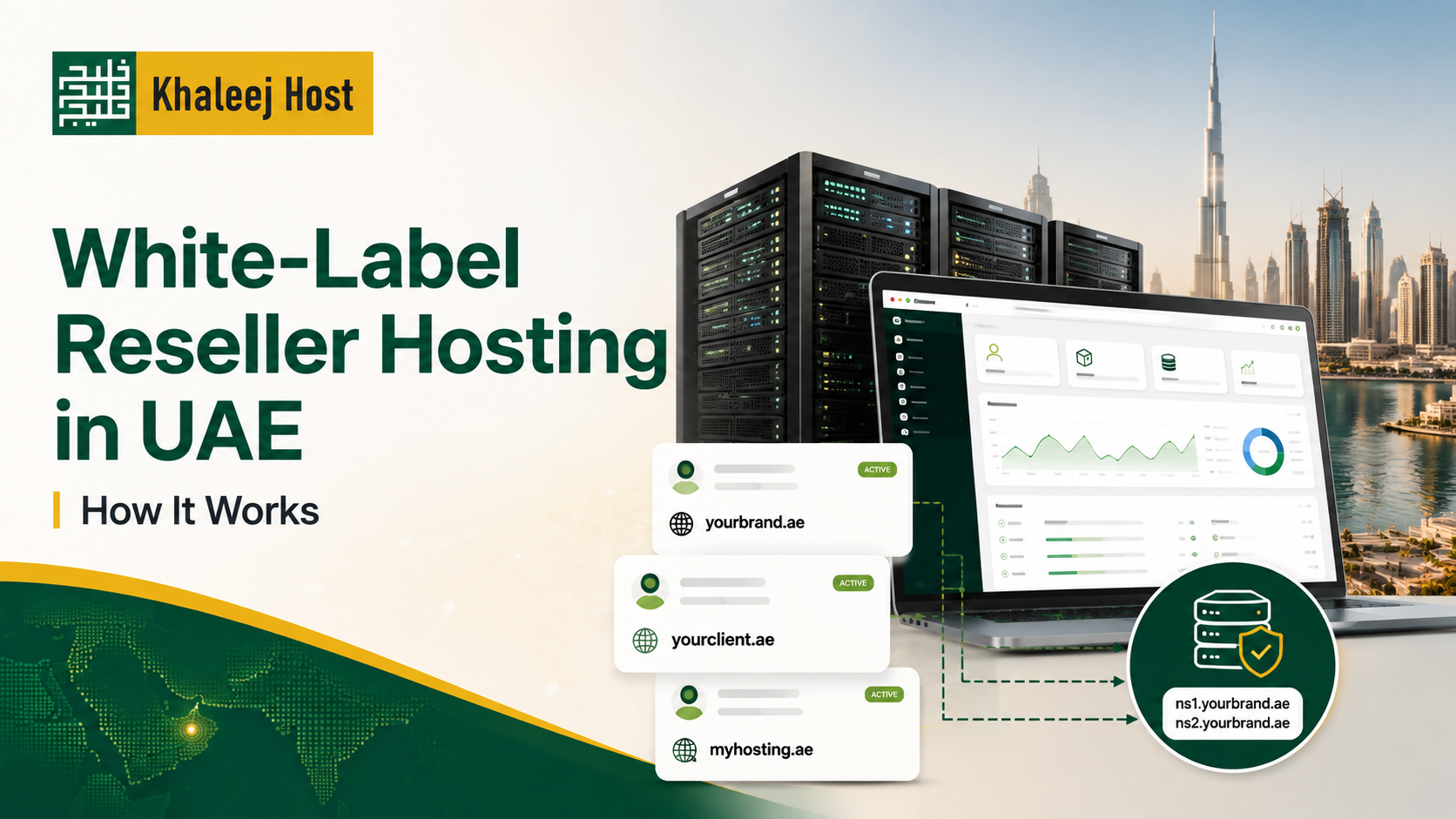
Building a hosting business does not always mean owning servers, managing data-centre infrastructure, or handling every server-level task yourself. With white-label reseller hosting in UAE, you can offer hosting under your own business name while the underlying infrastructure is provided and maintained by a hosting company.
For agencies, developers, IT companies, and entrepreneurs, this model creates a way to add hosting to an existing service portfolio without building a hosting infrastructure from scratch.
The important distinction is that your customers see your brand, not necessarily the company operating the infrastructure behind the service.
That can make white-label hosting useful for businesses that want to offer a complete digital service, from website development and domains to hosting, email, maintenance, and ongoing technical support.
If you are new to the reseller model, our guide to Reseller Hosting in UAE explains the broader business model, while this guide focuses specifically on how white-label hosting works and what you should consider before offering it to customers.
What Is White-Label Reseller Hosting?
White-label reseller hosting allows you to purchase hosting resources from a hosting provider and resell them to your own customers under your business identity.
The infrastructure provider remains responsible for the underlying hosting environment according to the service agreement. You manage the customer-facing side of the business.
A simple way to understand the model is:
Hosting provider → Your reseller account → Your brand → Your customers
Your customers can purchase hosting from your website, receive communications from your business, and manage their hosting accounts through the tools provided as part of your reseller environment.
The provider’s infrastructure may remain behind the scenes.
This is what makes the model different from simply referring customers to another hosting company.
How Does White-Label Hosting Work?
The process usually involves several connected layers.
1. You Choose a Reseller Hosting Provider
First, you select a hosting provider that offers reseller services and supports the level of branding you require.
You should review more than storage and bandwidth.
Important considerations include:
- Hosting resources
- Account limits
- WHM access
- cPanel availability
- Private nameservers
- Branding options
- Backup policies
- Support arrangements
- Security features
- Upgrade options
Your provider’s infrastructure ultimately affects the service your customers receive, so this decision deserves careful evaluation.
2. You Create Your Own Hosting Packages
After setting up your reseller account, you can create packages based on the types of customers you want to serve.
For example, you might offer:
Business Hosting
For small company websites and professional services.
WordPress Hosting
For customers running WordPress websites.
Agency Hosting
For freelancers, developers, and businesses managing multiple websites.
The exact resources assigned to each package should reflect the capacity and restrictions of your reseller environment.
Do not advertise resources that your hosting setup cannot reliably provide.
3. You Apply Your Own Brand
White-label hosting becomes useful when the customer-facing service reflects your business.
Depending on the provider and plan, this can involve:
- Your company name
- Your logo
- Branded hosting packages
- Custom customer communications
- Private nameservers
- Your website
- Your billing identity
- Your support channels
The objective is to create a consistent experience from purchase to account management.
For example, instead of directing a customer to an unrelated hosting company, your website can present hosting as one of your own services.
What Are Private Nameservers?
Private nameservers are commonly associated with branded reseller hosting.
A business may use nameservers such as:
ns1.yourbrand.com
ns2.yourbrand.com
rather than nameservers that visibly belong to the upstream hosting provider.
This can make the technical setup feel more closely connected to your own brand.
However, private nameservers do not mean that you own or operate the underlying servers. They are simply part of the DNS and branding structure used for the hosting service.
The exact configuration depends on your domain registrar and hosting provider.
Why Businesses Use White-Label Reseller Hosting
White-label hosting can solve a practical problem for businesses that already sell digital services.
Imagine a web development agency.
A customer approaches the agency for a website. The agency designs and launches the site, but the customer still needs somewhere to host it.
The agency has two choices.
It can send the customer to a third-party hosting company, or it can provide hosting as part of its own service.
With white-label reseller hosting, the second option becomes possible without requiring the agency to operate its own physical hosting infrastructure.
The same principle can apply to:
- Digital agencies
- Web developers
- Freelancers
- IT consultants
- Software companies
- Marketing agencies
- Managed service providers
The hosting service becomes another part of the relationship rather than a separate service the customer has to source elsewhere.
White-Label Hosting vs Regular Reseller Hosting
The two models are closely related, but branding is the key difference.
With standard reseller hosting, you purchase resources and create customer accounts, but the available branding may be limited.
With white-label reseller hosting, the goal is to present the service under your own business identity.
| Feature | Standard Reseller Hosting | White-Label Reseller Hosting |
| Resell hosting | Yes | Yes |
| Separate customer accounts | Usually | Usually |
| Custom packages | Usually | Usually |
| Own brand | Depends on provider | Core purpose |
| Private nameservers | Depends on plan | Often important |
| Customer-facing branding | Limited or provider-dependent | More extensive |
| Suitable for agencies | Yes | Yes |
| Suitable for branded hosting service | Limited | Stronger fit |
The exact features vary by provider, so always check what is included in the specific reseller plan.
Who Can Benefit From White-Label Hosting in UAE?
Web Design Agencies
Agencies can bundle hosting with website development and maintain the customer relationship after launch.
This can be especially useful when the agency wants to provide one point of contact for the website.
Freelance Web Developers
A freelancer managing multiple client websites can create hosting packages and manage accounts through a reseller environment.
Instead of sending each client to a different provider, the freelancer can offer hosting as part of the overall service.
Digital Marketing Agencies
A marketing agency may already manage a client’s website, landing pages, analytics, and SEO.
Hosting can become another relevant service within that relationship.
For example:
Website management + hosting + SEO + maintenance
This is often more useful than selling hosting as an isolated product.
IT Companies
IT providers can include hosting in broader technology packages.
Customers may prefer dealing with one provider for domains, hosting, email, website support, and other technical requirements.
Entrepreneurs Building a Hosting Brand
If your goal is to establish a dedicated hosting business, white-label reseller hosting can provide the infrastructure foundation while you focus on branding, sales, customer acquisition, and support.
What Do You Actually Manage as a White-Label Reseller?
One common misunderstanding is assuming that white-label hosting means the provider handles everything.
It does not.
Your responsibilities depend on the agreement, but you will generally manage the customer-facing side of the business.
This can include:
- Creating hosting packages
- Managing customer accounts
- Handling first-line support
- Managing billing
- Sending renewal reminders
- Managing customer communication
- Helping with DNS configuration
- Coordinating migrations
- Explaining hosting features
- Escalating infrastructure problems
Your hosting provider may handle infrastructure-level responsibilities such as the physical servers and underlying platform.
The exact division of responsibility depends on the provider.
Before launching, define those boundaries clearly.
What Should Your White-Label Hosting Packages Include?
A good hosting package should be easy for the customer to understand.
Avoid building packages around technical specifications alone.
Instead, explain what each package is designed for.
Starter Package
Suitable for:
- Small business websites
- Landing pages
- Personal websites
- Basic WordPress installations
Business Package
Suitable for:
- Growing business websites
- Professional service companies
- Business email
- Websites with higher resource requirements
Agency Package
Suitable for:
- Freelancers
- Developers
- Web agencies
- Multiple client websites
The exact storage, CPU, memory, account, database, and other limits should be determined by your reseller environment.
How Billing Works With White-Label Hosting
Billing is another important part of the customer experience.
Your customers should understand:
- What they are purchasing
- How often they are billed
- When renewal occurs
- What happens after non-payment
- Which services are included
- Which services cost extra
- How cancellations work
A hosting billing system can help automate recurring invoices, renewal reminders, account records, and other administrative tasks.
Automation becomes increasingly useful as your customer base grows.
It reduces the amount of manual work involved in managing recurring services and helps create a more organised customer experience.
How Customer Support Works
White-label hosting creates an important expectation.
The customer sees your company as the hosting provider.
That means they will normally contact you first when something goes wrong.
You should therefore establish a clear support process before launching.
For example:
Customer issue → Your support team → Initial troubleshooting → Provider escalation if required
Your support process should distinguish between hosting-related issues and website development issues.
Hosting support might include:
- DNS assistance
- cPanel guidance
- Email configuration
- Hosting account issues
- Basic hosting troubleshooting
Website development may involve:
- Custom coding
- Plugin conflicts
- Website redesign
- Content changes
- Theme development
- Application errors
These services can be offered separately if they fall outside your hosting support scope.
What Should You Check Before Choosing a White-Label Provider?
Choosing the provider is one of the most important decisions in the model.
Branding Capabilities
Check whether the provider supports the branding features you actually need.
Ask about:
- Private nameservers
- Custom branding
- Customer account branding
- Control-panel branding
- Billing integration
- White-label communication options
Resource Allocation
Understand the actual limits of the reseller account.
Look at:
- Storage
- CPU
- Memory
- Bandwidth
- Inodes
- Databases
- Account limits
- Process limits
Backup and Recovery
Do not simply ask whether backups exist.
Find out:
- How frequently backups are created
- How long they are retained
- How restoration works
- Whether restoration is included
- What happens after account deletion
For important customer websites, recovery procedures matter as much as backup availability.
Support
Your provider’s support becomes part of your own support operation.
Find out how infrastructure problems are escalated and what level of assistance reseller customers receive.
Scalability
Your first reseller package may be enough for a small portfolio.
Later, you may need more accounts or resources.
Check whether the provider offers a clear upgrade path before you commit.
Is White-Label Reseller Hosting Profitable?
White-label hosting can create recurring revenue, but profitability is not automatic.
Your results depend on several factors:
- Customer acquisition
- Hosting costs
- Customer retention
- Support workload
- Resource usage
- Billing and payment costs
- Additional services
- Upgrade requirements
The strongest business model is often not based on selling hosting as cheaply as possible.
Instead, build value around the hosting account.
For example:
Domain + Hosting + Business Email + Website Maintenance
Or:
Website Development + Hosting + Security + SEO
When hosting is part of a broader service relationship, customers have more reasons to stay with your business.
White-Label Hosting and Customer Trust
Branding alone does not create trust.
Your customers will judge the service based on what happens after they purchase.
That means your website should clearly explain:
- Hosting features
- Support availability
- Renewal terms
- Migration options
- Service limitations
- Terms and conditions
- Privacy information
- Contact details
Your invoices, emails, customer portal, and support communications should also be consistent.
A white-label model works best when the customer experience feels like a genuine service rather than a third-party product placed under a new logo.
Common Mistakes With White-Label Reseller Hosting
Treating Branding as the Whole Business
A logo and private nameservers are not enough.
You still need reliable processes for billing, support, onboarding, renewals, and customer communication.
Choosing the Cheapest Provider
A low-cost reseller plan may look attractive initially, but weak support or limited resources can create problems later.
Evaluate the complete service.
Promising More Than You Can Deliver
Do not advertise unlimited resources or support unless your service genuinely provides them under clearly defined terms.
Mixing Hosting and Website Support
A customer may expect you to fix every website problem simply because you provide hosting.
Define what hosting support includes before selling the service.
Ignoring Scalability
Your first few customers may fit comfortably within a small reseller account.
Plan for what happens when your customer base grows.
How KhaleejHost Fits Into a White-Label Hosting Strategy
For businesses targeting customers in the UAE, the reseller provider is an important part of the service model.
KhaleejHost can be considered when evaluating a hosting foundation for a branded reseller service. Before choosing a specific plan, businesses should compare the available resources, account limits, control-panel features, branding capabilities, support arrangements, backup policies, and upgrade options against their customer requirements.
This is particularly important if you plan to host multiple business websites rather than a single website.
Your choice should be based on the websites you expect to manage and the level of service you intend to provide.
For a broader understanding of the reseller model, you can also explore our guide on how to start a reseller hosting business in UAE, which covers customer targeting, package creation, onboarding, support, and business growth.
Build a White-Label Hosting Service Around Your Brand
White-label reseller hosting in UAE gives businesses a practical way to offer hosting without building their own physical infrastructure.
The technology is only one part of the equation.
Your success depends on how well you combine the hosting platform with:
- Clear packages
- Strong branding
- Reliable customer support
- Simple billing
- Defined service boundaries
- Useful additional services
- A sensible growth strategy
For agencies, developers, freelancers, and IT providers, hosting can become a natural extension of the services they already provide.
The best approach is to start with your customers, understand what their websites require, and then choose a reseller environment that can support those needs without unnecessary complexity.
If you are considering building a branded hosting service for UAE customers, review KhaleejHost reseller hostingoptions and compare the available features with your planned customer base and service model.
Frequently Asked Questions
White-label reseller hosting allows a business to sell hosting under its own brand while using infrastructure provided by another hosting company. The reseller manages the customer-facing service, while the infrastructure provider handles the underlying hosting environment according to the agreed service arrangement.
Yes, if the reseller provider offers appropriate white-label features. These may include private nameservers, custom branding, customer account branding, and other tools that help present the service under your business identity. The exact features depend on the provider and plan.
The purpose of white-label hosting is to allow the reseller to present the service under its own brand. However, businesses should not make misleading claims about ownership of infrastructure or services. Your terms and customer documentation should accurately describe your service arrangement where required.
No. One of the main advantages of reseller hosting is that you can sell hosting without owning or operating your own physical server. You purchase resources from an established provider and use the reseller environment to create and manage customer hosting accounts.
Yes. Web design agencies are a natural fit because hosting can be offered alongside website development, domain registration, maintenance, security, and other services. This allows the agency to continue serving the client after the website launches.
Private nameservers allow a reseller to use names associated with its own domain instead of visibly using the upstream provider’s nameservers. This can create a more consistent branded setup for customers. Private nameservers are a branding and DNS feature, not proof that the reseller owns the underlying server infrastructure.
The reseller should define its support scope clearly. Common responsibilities may include basic DNS assistance, hosting account guidance, cPanel help, email configuration, and first-line troubleshooting. Infrastructure-level problems can then be escalated to the upstream provider when necessary.
It can be a practical starting model because it reduces the need to build physical infrastructure from scratch. However, the business still needs proper customer support, billing, branding, onboarding, security practices, and service policies. Choosing the right provider is therefore just as important as creating the brand itself.