



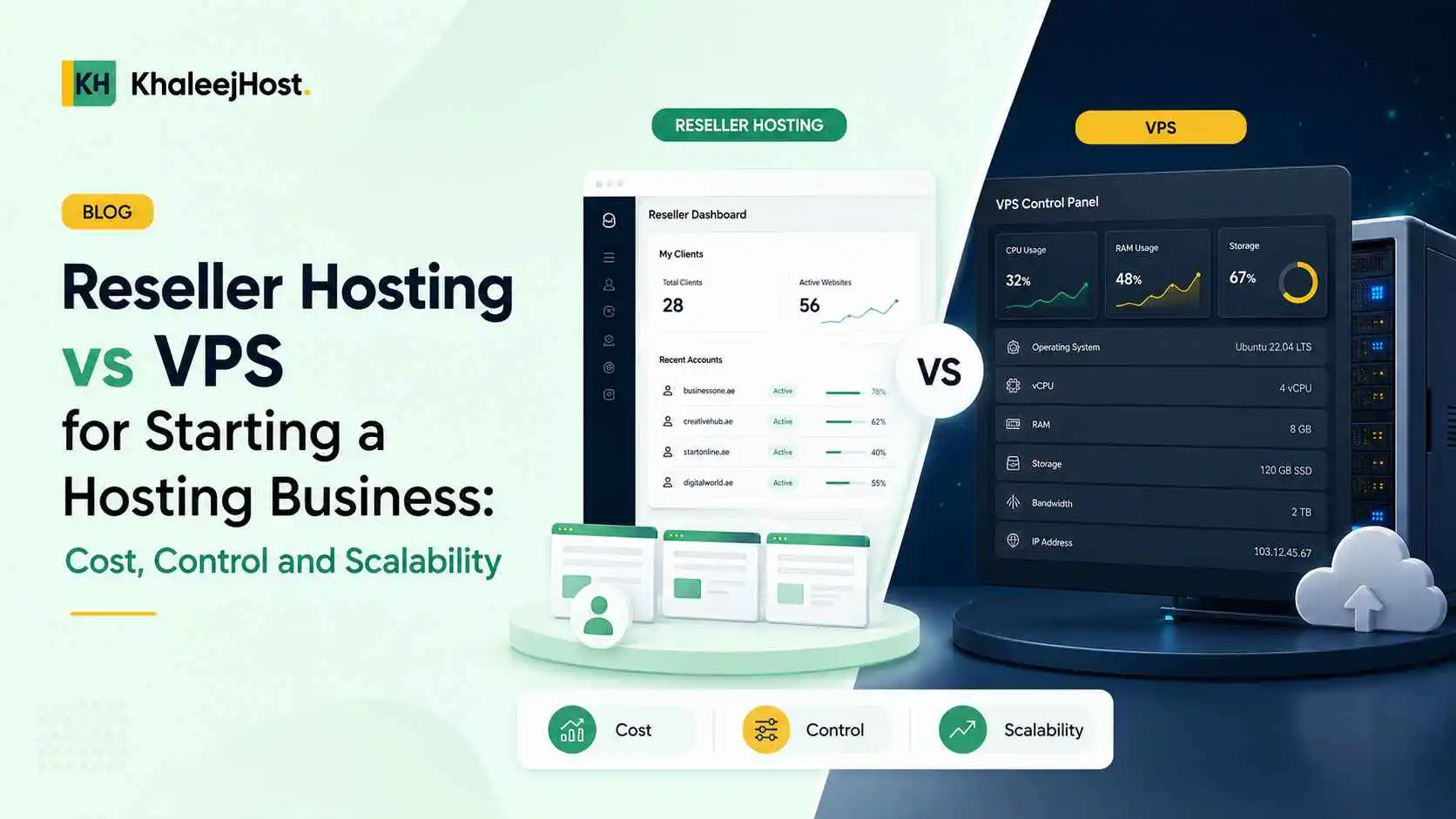
Choosing between reseller hosting vs VPS is one of the first major infrastructure decisions you may face when starting a hosting business.
Both options can support multiple websites and customers, but they are built around very different levels of control and responsibility.
Quick answer: Reseller hosting is generally better for beginners, agencies and entrepreneurs who want to sell hosting without managing the underlying server. A VPS is better when you need root access, custom server configurations or specialised applications and have the technical expertise to manage the environment.
With reseller hosting, you purchase hosting resources from an established provider and use them to create and manage customer accounts. The provider handles the underlying server infrastructure while you focus on your hosting packages, customers, billing, support, and brand.
A VPS gives you a virtual server environment with considerably more control. You can configure the operating system, software stack, security settings, and server resources according to your requirements. However, that control also means taking on more technical responsibility.
So, which one should you choose?
For most people launching their first hosting business, reseller hosting is the simpler starting point. A VPS becomes more attractive when your business requires deeper server-level control, custom configurations, or a more specialised hosting environment.
This guide compares reseller hosting and VPS hosting across cost, control, technical responsibility, performance, scalability, security, customer management, and long-term business growth.
If you are still learning the overall business model, start with our complete guide to Reseller Hosting in UAE before choosing your infrastructure.
Reseller Hosting and VPS Hosting Serve Different Purposes
The biggest mistake is treating reseller hosting and VPS hosting as two versions of the same product.
They solve different problems.
Reseller hosting is primarily designed for businesses that want to sell hosting services without managing the underlying server infrastructure themselves.
VPS hosting is designed for users who need their own virtual server environment and greater control over how that environment is configured.
In a reseller environment, your hosting provider controls the underlying server. Your reseller privileges allow you to create and manage customer hosting accounts within the resources and permissions assigned to you. cPanel’s documentation describes the reseller model as purchasing server resources and allocating them to individual cPanel accounts.
With a VPS, you have a separate virtual server environment and can generally make server-level configuration decisions that are not available within a standard reseller account.
That difference affects almost everything else.
Reseller Hosting vs VPS at a Glance
| Factor | Reseller Hosting | VPS Hosting |
| Setup | Easier | More involved |
| Server management | Mostly handled by provider | More responsibility for you |
| Control | Account-level | Server-level |
| Root access | Usually unavailable | Usually available, depending on setup |
| Customer accounts | Easy to manage through reseller tools | Requires your own setup |
| Technical knowledge | Moderate | Higher |
| Customisation | Limited by provider | Much greater |
| Maintenance responsibility | Lower | Higher |
| Scalability | Upgrade reseller resources or plan | Resize or move to larger infrastructure |
| Best for | New hosting businesses and agencies | Advanced hosting businesses and custom environments |
The important point is that neither option is automatically better.
The right choice depends on what your hosting business actually needs.
Starting a Hosting Business With Reseller Hosting
Reseller hosting is designed to make the commercial side of hosting easier to manage.
You purchase resources from a provider and use them to create hosting accounts for your customers.
With a typical WHM and cPanel environment, you can create customer accounts, assign packages, manage account settings, and organise multiple websites from a central interface. cPanel confirms that resellers can create and manage the cPanel accounts they own within the permissions assigned by the server administrator.
This creates a straightforward business structure:
Hosting provider → Your reseller account → Your hosting packages → Your customers
You are responsible for the customer relationship.
The provider remains responsible for the underlying infrastructure according to its service agreement.
That division of responsibility is one of the biggest advantages for someone entering the hosting market.
Starting a Hosting Business With a VPS
A VPS changes that division of responsibility.
Instead of operating inside a reseller environment, you have your own virtual server.
This gives you much more freedom.
You may be able to configure:
- Operating system settings
- Web server software
- PHP versions
- Server modules
- Databases
- Firewalls
- Security tools
- Monitoring systems
- Custom applications
- Background services
That flexibility is useful when your customers have requirements that a standard reseller environment cannot accommodate.
But there is an important trade-off.
More control means more responsibility.
A VPS can require you to manage server updates, security configuration, monitoring, backups, firewall rules, troubleshooting, and other infrastructure tasks.
A managed VPS can reduce some of that workload, but the exact level of management depends on the provider and service plan.
Cost: Which One Makes More Sense for a New Hosting Business?
Cost should not be judged by the monthly infrastructure price alone.
The real comparison is the total cost of operating the service.
With reseller hosting, many infrastructure responsibilities remain with the provider. You generally do not have to build the server environment yourself before you can start selling hosting.
With a VPS, the server itself may be only one part of the equation.
You may also need to consider:
- Control-panel licensing
- Server administration
- Security configuration
- Backup systems
- Monitoring
- Technical maintenance
- Migration work
- Troubleshooting
- Additional software
- Management time
For example, cPanel currently separates its licensing into different tiers, including cloud licenses designed for VPS and cloud environments.
That does not mean a VPS is always more expensive.
It means you should compare the complete operating model, not just the advertised server price.
For a new hosting business, reseller hosting can often make more sense when the priority is validating demand before taking on additional infrastructure responsibilities.
Control: VPS Clearly Has the Advantage
If control is your main requirement, VPS hosting wins.
A reseller account gives you access to the tools and permissions your provider assigns.
You can manage your customer accounts, packages, and other reseller functions, but you generally cannot change the underlying server environment freely.
That limitation is intentional.
The provider needs to maintain the server for multiple users.
A VPS gives you much more freedom to configure the environment around your own requirements.
This becomes important when you need:
- Custom server software
- Specific PHP configurations
- Additional services
- Custom background processes
- Special security configurations
- Application-specific dependencies
- Server-level optimisation
If your customers only need conventional websites, this additional control may not provide much practical value.
If you are hosting custom applications, advanced web projects, or specialised software, it can become essential.
Technical Responsibility Is Where the Biggest Difference Appears
This is perhaps the most important consideration for a new hosting business.
With reseller hosting, the infrastructure provider handles much of the server administration.
You still need hosting knowledge, but your responsibilities are focused more heavily on customers.
You may manage:
- Hosting accounts
- Packages
- Domains
- DNS
- Email settings
- SSL
- Customer support
- Website migrations
- Account resources
With a VPS, your responsibilities can extend much further into the server itself.
You may need to handle:
- Operating system updates
- Security patches
- Firewall configuration
- Server monitoring
- Web server configuration
- Database configuration
- Backup management
- Malware response
- Performance troubleshooting
This is why a VPS should not automatically be considered the “professional” option.
A more advanced server is not necessarily a better business decision.
If you do not need the additional control, the additional responsibility may simply create more work.
Performance Depends on More Than the Hosting Type
It is tempting to assume that VPS automatically means better performance.
The reality is more nuanced.
Performance depends on the actual infrastructure, available resources, configuration, workload, application requirements, and management quality.
A well-managed reseller environment can perform perfectly well for business websites, blogs, portfolios, landing pages, and many standard WordPress installations.
A VPS can provide greater resource isolation and more predictable control over the environment, but poor configuration can still result in performance problems.
So instead of asking:
“Is VPS faster than reseller hosting?”
ask:
“What resources and environment does my customer base actually require?”
That question leads to a much better infrastructure decision.
Customer Management Is Easier With Reseller Hosting
If your primary goal is to manage multiple customer hosting accounts, reseller hosting has a major advantage.
The reseller model is built around account management.
WHM allows resellers to manage the cPanel accounts they own, while hosting packages can define account limits such as disk space and bandwidth.
This means you can create a package for one type of customer and assign it to multiple accounts.
For example:
Starter Hosting
For small business websites.
Business Hosting
For growing websites with greater requirements.
Agency Hosting
For developers and agencies managing multiple websites.
The exact limits depend on the reseller environment provided by your hosting company.
With a VPS, you have the freedom to build a similar system, but you are responsible for putting more of that environment together.
Scalability: Both Can Grow, But Differently
Scalability is not simply about adding more storage.
Your hosting business may grow in several ways:
- More customer accounts
- Higher website traffic
- More resource-intensive websites
- More databases
- More email usage
- More support requirements
- More specialised applications
Reseller hosting generally scales by moving to a larger reseller plan or another suitable hosting environment.
This is relatively straightforward because the provider manages the underlying infrastructure.
VPS hosting gives you more flexibility in how you scale.
You may be able to increase CPU, RAM, storage, or other resources, depending on the provider and virtualisation platform.
You can also move toward more advanced architectures as your business develops.
That makes VPS more attractive for businesses that already know they will need greater infrastructure control.
Security Responsibility Changes With the Choice
Security is another area where the two models differ significantly.
With reseller hosting, many server-level security responsibilities remain with the infrastructure provider.
You are still responsible for securing your customer accounts, websites, passwords, applications, and access.
With a VPS, you may become responsible for securing the server itself.
That can include:
- Firewall configuration
- SSH security
- User permissions
- Software updates
- Server hardening
- Monitoring
- Malware detection
- Backup protection
A VPS gives you more control over security, but it also gives you more opportunities to configure something incorrectly.
For a new hosting business without dedicated server-management expertise, reducing unnecessary infrastructure responsibility can be a practical advantage.
White-Label Branding Works Naturally With Reseller Hosting
If your goal is to create a hosting business under your own brand, reseller hosting can provide a straightforward route.
Depending on the provider, you may be able to use:
- Private nameservers
- Branded hosting accounts
- Custom packages
- Client portals
- Branded communications
This allows your customers to interact primarily with your business rather than the upstream infrastructure provider.
If branding is important to your business model, review the provider’s exact white-label capabilities before purchasing a plan.
Reseller Hosting Is Often Better for Agencies
Web design and digital agencies frequently manage multiple client websites.
Their primary requirement may not be server-level customisation.
They may simply need:
- Reliable hosting
- Multiple customer accounts
- Easy account management
- Domain and DNS control
- Website migration
- Support
- White-label branding
In that situation, reseller hosting can provide the right balance.
The agency can focus on building websites and managing customers instead of spending time maintaining a server.
This also creates an opportunity to package hosting with other services such as website development, maintenance, business email, security, and SEO.
VPS Becomes More Attractive for Advanced Hosting Requirements
A VPS starts to make more sense when your business moves beyond conventional hosting requirements.
For example, you may need to host:
- Custom web applications
- Node.js applications
- Background workers
- Specialised APIs
- Custom server software
- Resource-intensive applications
- Services requiring specific system configurations
In these situations, a standard reseller environment may not provide the flexibility you need.
A VPS gives you greater freedom to build the server environment around the application.
The trade-off is that you also become responsible for managing more of that environment.
When Reseller Hosting Is the Better Choice
Reseller hosting is usually the stronger starting point when:
- You are launching your first hosting business
- You want to minimise server administration
- You manage standard business websites
- You need multiple customer accounts
- You want WHM and cPanel
- You want white-label hosting
- You already run a web design agency
- You want to validate your hosting business before expanding infrastructure
For many new resellers, this is enough.
There is no advantage in managing a server simply for the sake of saying that you manage a server.
When VPS Is the Better Choice
A VPS may be more appropriate when:
- You need root-level access
- You require custom software
- You need server-level configuration
- Your applications have specialised requirements
- You need greater resource control
- You have the technical expertise to manage the environment
- Your customer base has outgrown the limitations of your reseller setup
At that point, the additional responsibility may be justified by the additional control.
Reseller Hosting vs VPS for a New Hosting Business
If you are starting from zero, reseller hosting is usually the more practical first step.
Your early priorities should be:
- Finding customers
- Creating useful packages
- Building your brand
- Providing reliable support
- Managing billing
- Learning what your customers actually need
You do not need a highly customised server environment to accomplish those goals.
Once your business has real customers and real usage data, you can make a much more informed decision about infrastructure.
That is better than purchasing a VPS based on assumptions about future growth.
A Practical Growth Path
A hosting business does not have to choose one infrastructure model forever.
You can start with reseller hosting and move to a VPS when your requirements change.
A practical progression can look like this:
Stage 1: Validate
Start with reseller hosting.
Build your packages and acquire your first customers.
Stage 2: Optimise
Monitor resource usage, support requests, customer retention, and website requirements.
Improve your processes.
Stage 3: Expand
If your reseller environment becomes restrictive, evaluate larger reseller resources or a VPS.
Stage 4: Specialise
Once you need greater control, custom configurations, or specialised applications, a VPS may become the more suitable environment.
This approach lets your infrastructure grow with the business instead of forcing the business to grow around infrastructure it may not yet need.
Choosing the Right Hosting Provider Matters
Whichever model you choose, your hosting provider remains important.
For reseller hosting, look at:
- Resource allocation
- WHM and cPanel
- Account limits
- Backup policies
- Technical support
- White-label options
- Migration assistance
- Upgrade options
For VPS hosting, also consider:
- Virtualisation technology
- CPU and RAM allocation
- Storage type
- Network capacity
- Server management
- Security options
- Backup solutions
- Monitoring
- Root access
- Technical support
The right provider should match your technical ability and customer requirements.
Why KhaleejHost Can Be a Starting Point for Reseller Hosting
If your goal is to launch a hosting business in the UAE without immediately taking on full server administration, KhaleejHost hosting can be worth evaluating as part of your infrastructure options.
The key is to assess the reseller environment against your actual business requirements.
If your customers mainly need standard business websites, WordPress websites, domains, email, and ongoing website support, a reseller environment can provide a simpler operating model.
You can focus on your brand, packages, customer relationships, and support while the underlying infrastructure remains with the hosting provider.
As your requirements grow, you can then reassess whether a larger reseller environment, VPS, or another infrastructure model makes more sense.
Reseller Hosting vs VPS: The Right Choice for Your Hosting Business
There is no universal winner in the reseller hosting vs VPS comparison.
The better choice depends on what you are trying to build.
Choose reseller hosting when you want a simpler way to launch a hosting business, manage multiple customer accounts, offer white-label hosting, and avoid taking on full server-management responsibilities.
Choose a VPS when you need greater control, custom configurations, specialised software, or more direct control over the server environment.
For most new hosting businesses, starting with reseller hosting is a sensible approach.
It lets you prove the business model first.
You can learn what your customers need, understand your resource usage, build recurring relationships, and develop your support processes.
Then, when the limitations of reseller hosting become a genuine business problem, you can move to a VPS with a clear reason for doing so.
That is a much stronger approach than choosing the most powerful infrastructure before you have customers who actually need it.
Frequently Asked Questions
For many beginners, yes. Reseller hosting reduces server-management responsibilities and provides tools for managing multiple customer accounts. A VPS becomes more useful when you need server-level control or specialised configurations.
A VPS generally provides greater control over the server environment, but “more powerful” does not automatically mean “better.” For standard websites, the additional control may not provide meaningful benefits.
Yes. Many hosting businesses start with reseller hosting and move to a VPS or another infrastructure model as their technical and customer requirements grow. The migration process should be planned carefully to minimise disruption.
Yes. Agencies can manage multiple client websites, create separate hosting accounts, and combine hosting with website development, maintenance, email, security, and other services.
You need considerably more server-management knowledge than you typically need with reseller hosting, particularly with an unmanaged VPS. Managed VPS services can reduce some of this responsibility, but you should still understand what the provider manages and what remains your responsibility.
Both can scale, but they scale differently. Reseller hosting usually scales through larger plans or additional resources from the provider. VPS hosting provides more direct control over resource allocation and server configuration, which can be useful for advanced requirements.